


Page 3 - hypertension_newsletter5_draft2
P. 3
REFLECTIONS
                                                                                                                   Hypertension
     Hypertension Global Newsletter #5 2023


     Regarding drug treatment, the guidelines confirm starting with a two-drug combination for most patients at any treatment step.
     Combinations include an ACEi or ARB with a calcium channel blocker or a thiazide/thiazide-like diuretic, preferably in a single-pill
     combination, to reduce pill burden and improve adherence and outcomes. In specific populations such as HFrEF, the guidelines
                                                                                                                   Hypertension
     recommend combining drugs with documented outcome benefits, including an ACEi (ARB if not tolerated), which could be
     substituted by ARNI. In patients with hypertension and CAD, the initial step is also an ACEi (ARB if not tolerated) plus a beta-blocker.

     A new recommendation of the guidelines is the use of beta-blockers that can be used at any step of the treatment algorithm if there
     is a guideline-directed indication or other conditions for which they are thought to be beneficial, such as those with atrial fibrillation,
     chronic or acute coronary syndromes, and post-myocardial infraction, among other conditions.


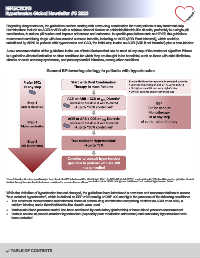
                             General BP-lowering strategy in patients with hypertension


                                                                 2
                                                                                  2
                                                                                              b
     a Use of diuretics: Consider transitioning to loop diuretic if eGFR is between 30 to 45 mL/min/1.73 m . If eGFR <30 mL/min/1.73m  use loop diuretic;  BB should be used as guideline-directed
     medical therapy in respective indications or considered in several other conditions;  controlled below 140/90 mmHg;  see definition of “true resistant hypertension” below.
                                                       c
                                                                           d
     While the definition of hypertension has not changed, the guidelines have introduced a new term and recommendations to assess
     “true resistant hypertension”, which is defined as SBP ≥140 mmHg or DBP ≥90 mmHg in the presence of the following conditions:
     •   The maximum recommended and tolerated doses of a three-drug combination comprising of either an ACEi or an ARB, a
        calcium blocker, and a thiazide/thiazide-like diuretic were used
     •   Inadequate blood pressure control has been confirmed by ambulatory (preferable) or home blood pressure measurement
     •   Various causes of pseudo-resistant hypertension (especially poor medication adherence) and secondary hypertension have
        been excluded


          TABLE OF CONTENTS

