


Page 2 - hypertension_newsletter5_draft2
P. 2
REFLECTIONS
                                                                                                                   Hypertension
     Hypertension Global Newsletter #5 2023


     GUIDELINES                                                                                                    Hypertension


     2023 ESH Guidelines for the management of arterial hypertension. The Task
     Force for the Management of Arterial Hypertension of the European Society
     of Hypertension endorsed by the European Renal Association (ERA) and the
     International Society of Hypertension (ISH).
     Mancia G, et al. J Hypertens. 2023 Jun 21. doi: 10.1097/HJH.0000000000003480. Online ahead of print.

     Five years after the ESH-ESC Guidelines, the European Society of Hypertension (ESH), together with ISH (International Society
     of Hypertension), clarifies several points; particularly, they provide clear advice on how to measure blood pressure, an upgraded
     position for beta-blockers in the treatment algorithms, a new definition and treatment recommendations for ‘true resistant
     hypertension’, and detail the management of hypertension in a number of special populations, including for the first time essential
     recommendations on hypertension in children, adolescents, and the transition to young hypertensive adults individuals.

     The correct measurement of blood pressure is of key importance in the management of hypertension and the new guidelines
     upgrade recommendations regarding the use of out-of-hospital BP measurements, and include a detailed algorithm on how to
     measure BP both at home and in the office.


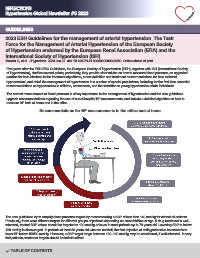
                         Recommendations for BP measurements in the office and at home


     The new guidelines try to simplify blood pressure targets by recommending a SBP of less than 140 mmHg for almost all patients.
     Previously, there were different targets for different groups of patients depending on comorbidities or age. If drug treatment is well-
     tolerated, treated SBP values should be targeted to 130 mmHg or lower in most patients up to 79 years old. Lowering SBP to below
     120 mmHg is discouraged. In patients at least 80 years old who are not frail, the first objective of antihypertensive treatment is to
     lower BP below 150/80 mmHg. However, a SBP target range between 130–139 mmHg may be considered, if well-tolerated. In very
     frail patients, treatment targets should be individualized.


          TABLE OF CONTENTS

